
Contents
- 🎵 Origins & History
- ⚙️ How It Works
- 📊 Key Facts & Numbers
- 👥 Key People & Organizations
- 🌍 Cultural Impact & Influence
- ⚡ Current State & Latest Developments
- 🤔 Controversies & Debates
- 🔮 Future Outlook & Predictions
- 💡 Practical Applications
- 📚 Related Topics & Deeper Reading
- Frequently Asked Questions
- References
- Related Topics
Overview
The concept of grid stability emerged with the very first interconnected electrical systems in the late 19th century. Early pioneers like Thomas Edison and Nikola Tesla grappled with maintaining consistent voltage and preventing cascading failures as their direct current (DC) and alternating current (AC) systems expanded. The widespread adoption of AC, championed by George Westinghouse and enabled by Michael Faraday's principles of electromagnetic induction, allowed for long-distance transmission and the development of large, centralized power plants. The inherent inertia of massive rotating generators in these plants provided a natural buffer against disturbances, a characteristic that defined grid stability for over a century. The formation of entities like the North American Electric Reliability Corporation (NERC) in 1968, following major blackouts like the 1965 Northeast blackout, formalized the need for stringent operational standards and reliability coordination across interconnected grids. The development of sophisticated load-following and frequency regulation techniques became paramount as grids grew in complexity and interconnectedness.
⚙️ How It Works
At its core, grid stability relies on maintaining a delicate equilibrium between electricity generation and consumption, measured by voltage and frequency. In a synchronous grid, all generators must operate at the same frequency (e.g., 60 Hz in North America, 50 Hz in Europe). When demand increases, generators must ramp up output; when demand falls, they must decrease it. Disturbances, such as a generator tripping offline or a sudden surge in demand, can cause frequency and voltage deviations. Inertial response from rotating generators acts as a shock absorber, momentarily resisting these changes. Modern grids employ sophisticated control systems, including Automatic Generation Control (AGC) and Phasor Measurement Units (PMUs), to monitor grid conditions in real-time and deploy corrective actions. Grid-forming-inverters, crucial for integrating renewables, can actively control voltage and frequency, mimicking the behavior of traditional generators.
📊 Key Facts & Numbers
The global electricity grid is a colossal infrastructure, with an estimated installed generation capacity exceeding 8,000 gigawatts (GW) as of 2023. Maintaining stability requires precise control; a deviation of just 0.1 Hz from the nominal frequency can trigger protective relays and potentially lead to blackouts. The U.S. Eastern Interconnection, for instance, spans over 26 states and parts of Canada, encompassing hundreds of millions of people. Energy storage systems, critical for future stability, are projected to reach over 1,000 GW of capacity globally by 2030, a tenfold increase from 2022 levels. The cost of grid instability is staggering; the 2003 Northeast blackout alone caused an estimated $6 billion in economic losses. Ensuring grid reliability often means maintaining a reserve margin of 15-20% above peak demand, a significant operational cost.
👥 Key People & Organizations
Key figures in grid stability include William F. Vernon, a former president of the IEEE, who advocated for advanced grid modernization. Organizations like the International Electrotechnical Commission (IEC) develop global standards for grid equipment and operation. NERC plays a crucial role in setting and enforcing reliability standards across North America. Research institutions like MIT and Stanford University are at the forefront of developing new technologies and control strategies for a stable, renewable-heavy grid. Siemens AG and General Electric are major players in providing grid control and automation technologies, while Tesla Inc.'s advancements in battery storage are reshaping the landscape of grid-scale energy solutions.
🌍 Cultural Impact & Influence
Grid stability is the silent enabler of modern life, underpinning everything from the internet and financial markets to healthcare and transportation. The cultural perception of electricity is one of absolute reliability; a flicker is an anomaly, a blackout a crisis. This expectation is built on decades of engineering and operational excellence. The visual spectacle of massive power plants and intricate transmission lines, while impressive, belies the constant, invisible dance of electrons managed by sophisticated control systems. The increasing integration of distributed energy resources (DERs) like rooftop solar and electric vehicles is democratizing energy production but also decentralizing control, shifting the cultural narrative from centralized power to a more dynamic, networked system. The very concept of 'turning on a light' is a testament to the success of grid stability efforts worldwide.
⚡ Current State & Latest Developments
The most significant current development is the integration of variable renewable energy (VRE) sources like solar and wind into grids historically designed for dispatchable fossil fuel or nuclear power. These VREs lack the inherent inertia of synchronous generators, making the grid more susceptible to rapid frequency fluctuations. This has spurred innovation in grid-forming-inverters, which can actively establish voltage and frequency, and the deployment of grid-scale battery storage. AI and machine learning are increasingly used for advanced forecasting of renewable generation and load demand, enabling more proactive grid management. The concept of the smart grid is rapidly evolving, with enhanced communication and control capabilities being deployed across transmission and distribution networks, aiming for greater resilience and efficiency. The ongoing debate around grid modernization investments, particularly in the United States, highlights the tension between upgrading aging infrastructure and the rapid pace of technological change.
🤔 Controversies & Debates
A central controversy revolves around the pace and cost of grid modernization required to accommodate renewables. Critics argue that traditional grid operators are too slow to adapt, clinging to outdated models that prioritize inertia over flexibility. The debate over the role of nuclear power as a stable, low-carbon baseload source versus the potential of advanced energy storage and demand-side management to provide similar grid services is ongoing. Furthermore, the cybersecurity of increasingly digitized grids is a major concern, with potential for malicious actors to disrupt power flow. The economic implications of grid upgrades, often passed on to consumers, are also a point of contention, particularly in regions with high energy costs. The question of whether to invest in strengthening the existing synchronous grid or to explore more asynchronous or modular grid architectures remains a significant point of divergence among experts.
🔮 Future Outlook & Predictions
The future of grid stability points towards a more decentralized, digitized, and flexible system. Expect to see a massive expansion of battery storage at all scales, from utility-scale installations to residential units, providing essential grid services like frequency regulation and peak shaving. Green hydrogen is emerging as a potential long-duration energy storage solution and a pathway for decarbonizing heavy industry, which will impact grid load patterns. Vehicle-to-grid (V2G) technology, allowing electric vehicles to feed power back into the grid, could unlock vast distributed storage capacity. Advanced control systems leveraging AI and blockchain for secure energy trading will become commonplace. The development of 'super grids' or continental-scale transmission networks could further enhance stability by allowing for the sharing of renewable resources across vast geographical areas, mitigating local intermittency.
💡 Practical Applications
Grid stability is not an abstract concept; it has direct, tangible applications. In utility operations, it ensures the lights stay on for millions, preventing economic disruption and maintaining public safety. For renewable energy developers, understanding grid stability is crucial for interconnecting their projects, as grid operators require them to meet specific performance standards. Energy storage solutions, a direct application of grid stability principles, are now deployed to smooth out the output of solar and wind farms, provide backup power during outages, and manage peak demand. Demand-response programs incentivize consumers to reduce electricity usage during critical periods, directly contributing to grid stability by lowering peak loads. The design and operation of microgrids, which can operate independently or connected to the main grid, are entirely predicated on maintaining internal stability.
Key Facts
- Year
- Late 19th Century - Present
- Origin
- Global
- Category
- technology
- Type
- concept
Frequently Asked Questions
What is the primary goal of grid stability?
The primary goal of grid stability is to ensure the continuous and reliable delivery of electricity from power generators to consumers. This means maintaining voltage and frequency within acceptable limits, even when faced with sudden changes in demand or unexpected disruptions like generator failures. Without stability, power outages would be frequent and widespread, crippling modern infrastructure and daily life. It's the invisible force that keeps our lights on and our digital world running.
How has the rise of renewable energy impacted grid stability?
The rise of renewable energy sources like solar and wind has significantly challenged traditional grid stability models. Unlike fossil fuel or nuclear power plants with large rotating generators that provide inherent inertia, renewables are often connected via inverters and are intermittent. This means they don't naturally resist frequency changes as effectively. Grid operators must now employ advanced forecasting, energy storage systems, and new control technologies like grid-forming inverters to compensate for the reduced inertia and variability introduced by these clean energy sources.
What are the key components that ensure grid stability?
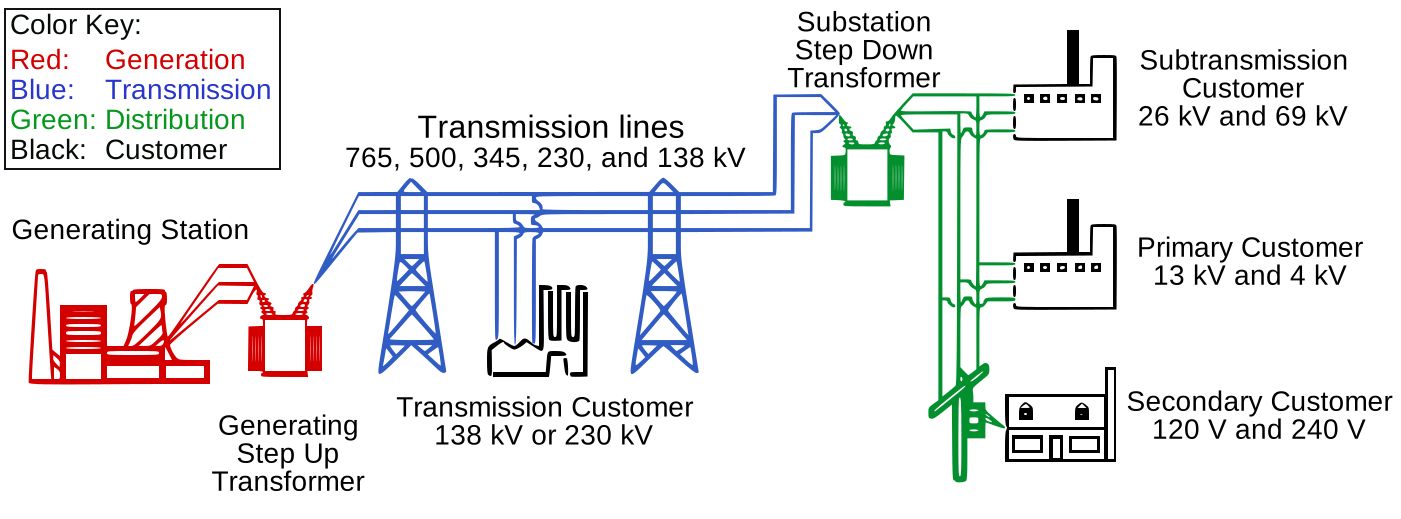
Key components ensuring grid stability include synchronous generators, which provide inertia and frequency regulation; advanced control systems like Automatic Generation Control (AGC) and Phasor Measurement Units (PMUs) for real-time monitoring and response; energy storage systems (e.g., batteries) to absorb and release power as needed; and sophisticated transmission and distribution networks. Grid-forming inverters are also becoming critical for integrating renewable energy sources by actively controlling voltage and frequency.
What happens when a grid becomes unstable?
When a grid becomes unstable, it can lead to a cascade of failures. Initial disturbances can cause frequency and voltage deviations, triggering protective relays that disconnect equipment to prevent damage. If these disturbances are severe or widespread, they can lead to rolling blackouts or complete grid collapse, known as a blackout. This results in widespread power loss, affecting everything from transportation and communication to healthcare and essential services, often with significant economic and social consequences.
Is the grid becoming less stable with more renewables?
The grid is not inherently becoming 'less stable' but rather requires new methods to maintain stability as renewable penetration increases. The challenge lies in managing the reduced inertia and variability of renewables. While traditional grids relied on the physical properties of large rotating machines, modern grids are increasingly managed by sophisticated digital controls, advanced forecasting, and flexible resources like battery storage and demand response. This transition is complex and requires significant investment and technological innovation, but the goal is to achieve a stable grid powered by a higher percentage of clean energy.
How can I contribute to grid stability as a consumer?
As a consumer, you can contribute to grid stability through participation in demand-response programs, which incentivize reducing electricity usage during peak demand periods. If you have rooftop solar and battery storage, utilizing smart home devices that can optimize energy consumption or even feed power back to the grid (Vehicle-to-Grid technology) can help. Simply being mindful of energy consumption, especially during critical times, and investing in energy-efficient appliances also collectively supports grid stability by reducing overall demand.
What is the future of grid stability technology?
The future of grid stability technology is characterized by increased decentralization, digitalization, and intelligence. Expect widespread deployment of utility-scale and distributed battery storage, the integration of green hydrogen for long-duration storage, and the maturation of vehicle-to-grid (V2G) capabilities. Advanced AI and machine learning will be crucial for predictive analytics and real-time control, while enhanced cybersecurity measures will protect increasingly interconnected systems. The development of continental-scale transmission networks ('super grids') may also play a role in enhancing stability by pooling diverse renewable resources.