
Contents
Overview
Memory is the mental faculty responsible for encoding, storing, and retrieving information, playing a crucial role in language, relationships, and personal identity. It is an information processing system consisting of sensory processing, short-term memory, and long-term memory, with explicit and implicit functioning. Memory loss, or amnesia, can significantly impact an individual's ability to learn and interact with their environment. The concept of memory has been studied extensively in the fields of psychology and neuroscience, with key components including long-term memory, short-term memory, creation, recall, implicit memory, and explicit memory. As Elizabeth Loftus has shown, memory can be influenced by various factors, including suggestion and manipulation, making it a complex and multifaceted topic. Furthermore, Daniel Schacter has demonstrated the importance of memory in shaping our sense of self and identity, emphasizing the need for continued research in this field.
🎵 Origins & History
Origins paragraph — Memory has been a subject of interest for thousands of years, with ancient civilizations recognizing its importance in learning and personal development. The concept of memory was first studied by philosophers, who believed that memory was a fundamental aspect of human cognition. Today, memory is a major area of research in psychology, neuroscience, and computer science, with applications in fields such as education, artificial intelligence, and cognitive psychology.
⚙️ How It Works
How it works — Memory is often understood as an information processing system with explicit and implicit functioning, consisting of a sensory processor, short-term (or working) memory, and long-term memory. The sensory processor allows information from the outside world to be sensed in the form of chemical and physical stimuli and attended to various levels of focus and intent. Working memory serves as an encoding and retrieval processor, with information in the form of stimuli being encoded in accordance with explicit or implicit functions by the working memory processor. This process is influenced by various factors, including attention, motivation, and prior knowledge.
📊 Key Facts & Numbers
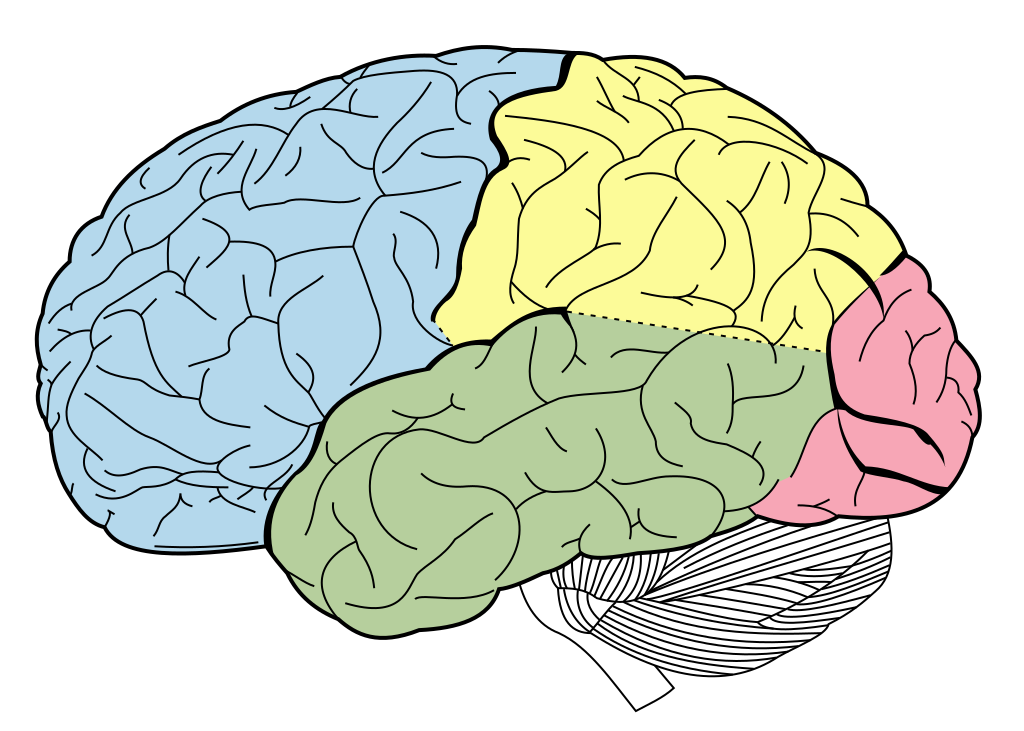
Key facts — Memory is a complex cognitive process that involves multiple brain regions. Research has shown that memory can be improved through practice, repetition, and spaced repetition. Additionally, memory can be influenced by various factors, including sleep, nutrition, and stress, with studies showing that sleep deprivation can significantly impair memory performance.
👥 Key People & Organizations
Key people — The study of memory has been shaped by the contributions of many researchers and scientists. Elizabeth Loftus has shown that memory can be influenced by various factors, including suggestion and manipulation. Daniel Schacter has demonstrated the importance of memory in shaping our sense of self and identity.
🌍 Cultural Impact & Influence
Cultural impact — Memory has had a significant impact on culture and society, with the development of writing systems, libraries, and other forms of information storage and retrieval. The concept of memory has also been explored in literature, art, and music, with works showcasing the importance of memory in human experience.
⚡ Current State & Latest Developments
Current state — Current research in memory is focused on understanding the neural mechanisms underlying memory formation and retrieval, as well as developing new treatments for memory-related disorders. The use of functional magnetic resonance imaging (fMRI) and other neuroimaging techniques has allowed researchers to study the brain's memory systems in greater detail, with studies showing that memory can be improved through cognitive training and neuroplasticity-based interventions.
🤔 Controversies & Debates
Controversies — There are several controversies and debates in the field of memory research, including the nature of consciousness and the role of memory in shaping our sense of self. Some researchers argue that memory is a fundamental aspect of consciousness, while others argue that consciousness is a separate entity from memory.
🔮 Future Outlook & Predictions
Future outlook — The future of memory research is likely to involve the development of new technologies and treatments for memory-related disorders, as well as a greater understanding of the neural mechanisms underlying memory formation and retrieval. The use of artificial intelligence and machine learning algorithms to study and improve memory is also a promising area of research.
💡 Practical Applications
Practical applications — Memory has many practical applications in fields such as education, artificial intelligence, and cognitive psychology. Techniques such as spaced repetition and chunking can be used to improve memory performance, while the development of new technologies such as brain-computer interfaces and neuroprosthetics is likely to revolutionize the field of memory research.
Key Facts
- Category
- science
- Type
- concept