
Contents
Overview
Global climate refers to the long-term average weather patterns that characterize regions and the planet as a whole. It encompasses temperature, precipitation, wind, and other atmospheric conditions over extended periods, typically 30 years or more. While Earth's climate has naturally fluctuated throughout its history, the current era is defined by rapid, human-induced changes, primarily driven by the emission of greenhouse gases like carbon dioxide from the burning of fossil fuels since the Industrial Revolution. This anthropogenic forcing has led to a measurable increase in global average temperatures, a phenomenon known as global warming, with profound and widespread impacts on ecosystems, sea levels, and extreme weather events. Understanding global climate is crucial for predicting future environmental conditions and developing strategies for mitigation and adaptation.
🎵 Origins & History
The concept of 'climate' as distinct from 'weather' emerged in scientific discourse during the 18th century. The understanding of global climate as a unified, interconnected system gained traction in the 20th century. The realization that human activities could alter this global system, however, truly solidified in the latter half of the 20th century. The establishment of the Intergovernmental Panel on Climate Change (IPCC) in 1988 marked a pivotal moment, consolidating scientific consensus and providing regular, comprehensive assessments of climate change.
⚙️ How It Works
Global climate operates through a complex interplay of energy transfer and atmospheric/oceanic circulation. Solar radiation warms the Earth's surface, which then radiates heat back into the atmosphere. Greenhouse gases, such as CO2, methane, and nitrous oxide, trap a portion of this outgoing heat, a process known as the greenhouse effect. Variations in solar output, volcanic activity, and atmospheric composition have historically driven climate shifts. Currently, the dominant factor is the increased concentration of these gases due to human activities like burning fossil fuels, deforestation, and industrial processes, leading to a net warming of the planet. Ocean currents, like the Gulf Stream, play a critical role in distributing heat globally, influencing regional climates.
📊 Key Facts & Numbers
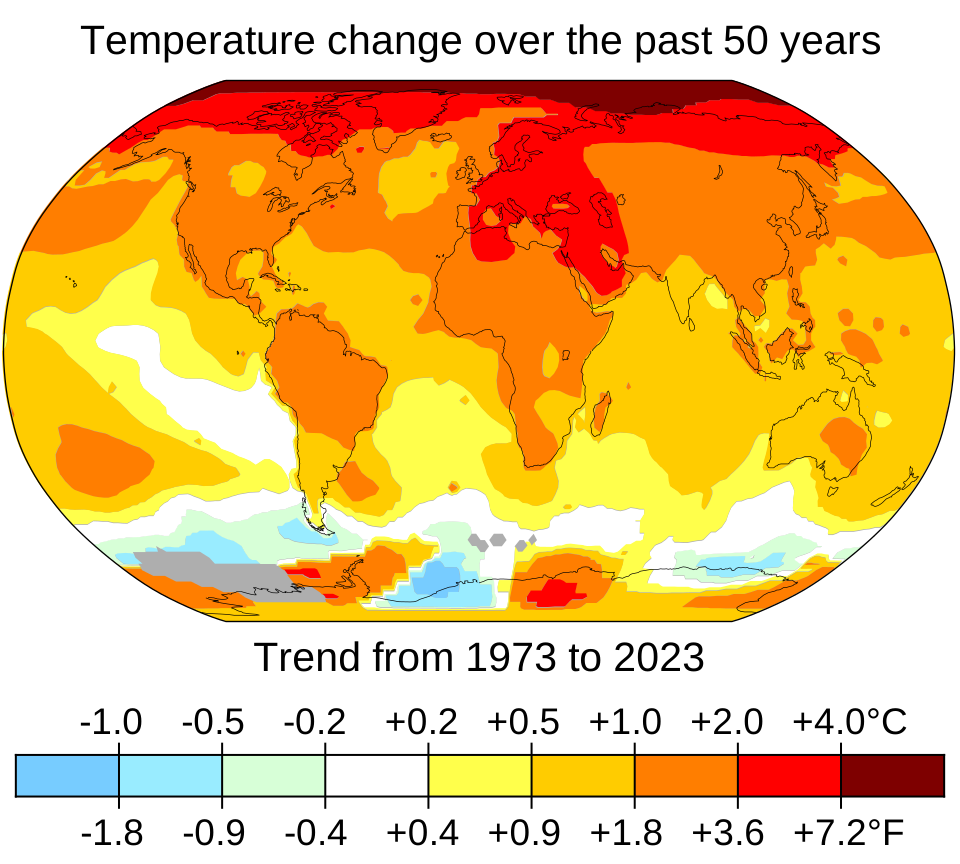
The Earth's average surface temperature has risen by approximately 1.1 degrees Celsius (2 degrees Fahrenheit) since the late 19th century, according to data from organizations like NASA GISS and the Met Office Hadley Centre. Atmospheric CO2 concentrations now exceed 420 parts per million (ppm), a level not seen in at least 800,000 years, and significantly higher than the pre-industrial level of around 280 ppm. Global sea levels have risen by about 20 centimeters (8 inches) in the last century, and the rate of rise has accelerated. The Arctic is warming at more than twice the global average rate. Extreme weather events, such as heatwaves and heavy precipitation, have increased in frequency and intensity in many regions, with studies indicating a 10-20% increase in the probability of certain extreme events due to warming.
👥 Key People & Organizations
Key organizations driving the understanding and response to global climate include the IPCC, which synthesizes climate science for policymakers, and national meteorological agencies like the NOAA and the UK's Met Office. Prominent research institutions such as the National Center for Atmospheric Research (NCAR) and the Potsdam Institute for Climate Impact Research (PIK) conduct vital research. Leading scientists in the field include James Hansen, whose early warnings about global warming were highly influential, and Syukuro Manabe, a pioneer in climate modeling who shared the Nobel Prize in Physics in 2021 for his work. The Global Climate Forum is a notable research network focusing on climate change economics and policy.
🌍 Cultural Impact & Influence
Global climate change has permeated nearly every facet of culture, from art and literature to political discourse and everyday consumer choices. Documentaries like Al Gore's "An Inconvenient Truth" (2006) brought the issue to mainstream attention, while fictional works, such as Kim Stanley Robinson's Mars trilogy, explore potential futures shaped by climate impacts. The rise of the Extinction Rebellion movement and the global youth climate strikes, inspired by figures like Greta Thunberg, demonstrate the profound cultural and social mobilization around the issue. Consumer trends towards sustainability, electric vehicles, and plant-based diets reflect a growing cultural awareness and a desire to align personal actions with environmental concerns, influencing industries from fashion to food production.
⚡ Current State & Latest Developments
The current state of global climate is characterized by accelerating warming trends and increasingly visible impacts. The year 2023 was the hottest on record, with global average temperatures reaching approximately 1.45°C above the pre-industrial baseline, according to the World Meteorological Organization (WMO). This warming has been accompanied by widespread extreme weather, including devastating heatwaves in Europe and North America, severe flooding in Libya and Pakistan, and intense wildfires in Canada and Hawaii. International efforts continue, with the UNFCCC's Conference of the Parties (COP) meetings, such as COP28 in Dubai, attempting to forge consensus on emission reductions and adaptation finance, though progress remains contentious. The development and deployment of renewable energy technologies like solar and wind power are rapidly increasing, but not yet at a pace sufficient to meet Paris Agreement targets.
🤔 Controversies & Debates
The most significant controversy surrounding global climate centers on the extent to which human activities are responsible for observed warming and the appropriate policy responses. While the overwhelming scientific consensus, as articulated by the IPCC, attributes current warming to anthropogenic greenhouse gas emissions, a vocal minority, often funded by fossil fuel interests, has historically questioned this link or downplayed its severity. Debates also rage over the economic costs of climate action versus the costs of inaction, the equitable distribution of burdens between developed and developing nations, and the efficacy and potential unintended consequences of various mitigation strategies, such as carbon capture or geoengineering.
🔮 Future Outlook & Predictions
Future outlooks for global climate range from cautiously optimistic to deeply pessimistic, largely depending on the speed and scale of global decarbonization efforts. Climate models project continued warming throughout the 21st century, with the magnitude dependent on future emission pathways. Scenarios from the IPCC suggest that limiting warming to 1.5°C or 2°C above pre-industrial levels requires immediate, rapid, and large-scale reductions in greenhouse gas emissions. Failure to achieve these targets could lead to more severe impacts, including widespread sea-level rise threatening coastal cities, increased frequency of extreme weather events, and potential tipping points in the climate system, such as the collapse of major ice sheets or the Amazon rainforest. The development of AI is expected to play a significant role in both climate modeling and the optimization of renewable energy systems.
💡 Practical Applications
Understanding global climate has direct practical applications in numerous fields. Agriculture relies on climate data for crop planning, irrigation strategies, and predicting yields. Urban planning uses climate projections to design infrastructure resilient to heatwaves, flooding, and sea-level rise. The insurance industry uses climate models to assess risks and set premiums for extreme weather events. Energy sector planning involves forecasting demand and optimizing the integration of renewable energy sources, which are inherently climate-dependent. Furthermore, climate science informs international policy, conservation efforts for biodiversity, and public hea
Key Facts
- Category
- science
- Type
- topic