
Contents
Overview
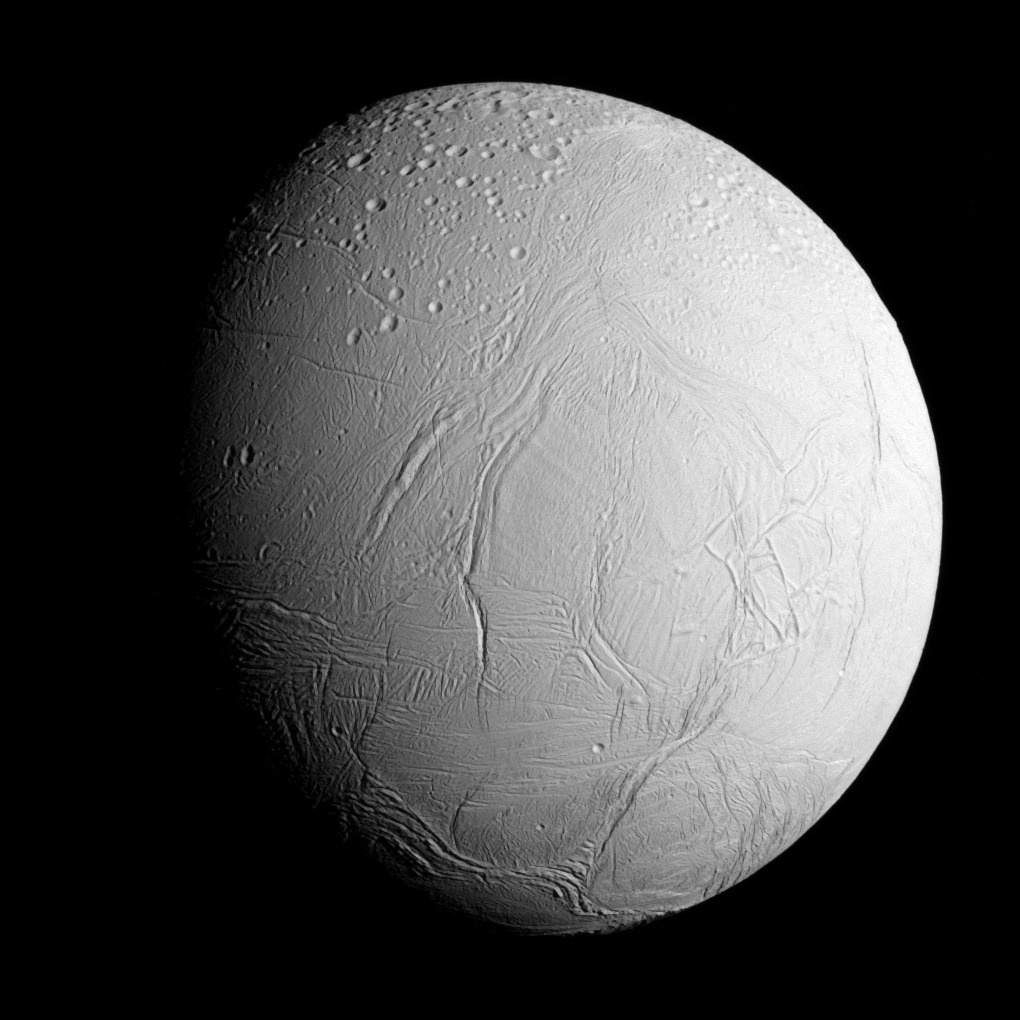
The discovery of Enceladus dates back to August 28, 1789, by Sir William Herschel, using his powerful 40-foot telescope. For nearly two centuries, it remained a relatively enigmatic icy body, with early observations by the Voyager 1 and 2 spacecraft in 1980 and 1981 providing only a glimpse of its cratered, icy surface. The true revolution in our understanding of Enceladus began with the arrival of the Cassini-Huygens mission in the Saturnian system in 2004. Cassini's multiple close flybys, starting in 2005, were instrumental in revealing the moon's dynamic nature, particularly the astonishing discovery of water-rich plumes erupting from its south polar region, fundamentally altering our perception of this small moon.
⚙️ How It Works
Enceladus's most remarkable feature is its cryovolcanism, specifically the geysers located in the "tiger stripe" region near its south pole. These fissures, approximately 130 kilometers (80 miles) long, spew plumes of water vapor, ice particles, and trace organic molecules into space. The Cassini spacecraft flew directly through these plumes, collecting samples that confirmed their composition and origin from a subsurface liquid water reservoir. Gravitational measurements and libration (wobble) analysis by Cassini further support the existence of a global or near-global subsurface ocean, estimated to be 10 kilometers (6 miles) deep, lying beneath an ice shell 30-40 kilometers (20-25 miles) thick. Tidal heating, generated by the gravitational tug-of-war between Enceladus and the massive Saturn, is believed to be the energy source keeping this ocean liquid.
📊 Key Facts & Numbers
Enceladus is the sixth-largest of Saturn's moons, with a mean radius of 252.1 kilometers (156.6 miles) and a diameter of approximately 500 kilometers (310 miles). Its surface is one of the most reflective in the Solar System, with an albedo of 0.99, meaning it reflects 99% of incident sunlight. This extreme reflectivity contributes to its frigid surface temperature, averaging around -198°C (-324°F). The total mass of Enceladus is estimated to be 1.08 x 10^20 kg, with a density of 1.24 g/cm³, indicating a composition of roughly 50% water ice and 50% rock. The plumes erupting from its south pole can reach heights of up to 500 kilometers (310 miles) above the surface, and Cassini detected approximately 250 kg of water being ejected per second.
👥 Key People & Organizations
The scientific community's understanding of Enceladus has been profoundly shaped by the Cassini-Huygens mission, a joint project of NASA, the European Space Agency (ESA), and the Italian Space Agency (ASI). Key individuals who spearheaded the analysis of Cassini data include Dr. Carolyn Porco, who led the Cassini Imaging Science Team and was instrumental in highlighting the significance of the Enceladus plumes, and Dr. Jacques Encrenaz, who contributed to the analysis of organic molecules. The initial discovery of Enceladus was made by Sir William Herschel in 1789. Future exploration efforts are being championed by organizations like the Planetary Science Institute and various university research groups.
🌍 Cultural Impact & Influence
The discovery of liquid water and organic molecules on Enceladus has catapulted it into the forefront of astrobiological research and popular science discussions. It has become a compelling analogue for potential habitats beyond Earth, fueling imaginations about the possibility of life elsewhere. The iconic images of Saturn and its rings, often featuring Enceladus as a tiny, bright point, have become staples in astronomical outreach and education. The moon's geysers have inspired speculative fiction and scientific proposals for missions designed to directly sample these plumes for biosignatures, solidifying its place in the cultural narrative of space exploration.
⚡ Current State & Latest Developments
As of 2024, the focus on Enceladus remains high, driven by the tantalizing implications of its subsurface ocean. While the Cassini mission concluded in 2017, its vast dataset continues to be analyzed, yielding new insights into the moon's geology and chemistry. Proposals for dedicated Enceladus missions, such as the Enceladus Orbilander and the Enceladus Life Finder (ELF), are actively being developed and debated within space agencies like NASA and ESA. These future missions aim to conduct more detailed in-situ analysis of the plumes and potentially land on the surface to search for definitive evidence of life.
🤔 Controversies & Debates
The primary controversy surrounding Enceladus centers on the interpretation of the Cassini data regarding its subsurface ocean and the potential for habitability. While the evidence for a liquid water ocean is strong, some scientists debate its exact extent (global vs. regional) and the presence of essential chemical ingredients for life, such as hydrothermal vents. The debate over whether Enceladus harbors life, or could harbor life, is ongoing, with proponents citing the presence of water, energy (tidal heating), and organic molecules as strong indicators, while skeptics emphasize the need for more direct evidence and the challenges of subsurface exploration. Another point of discussion is the optimal strategy for future missions: plume sampling versus direct surface or subsurface exploration.
🔮 Future Outlook & Predictions
The future outlook for Enceladus exploration is exceptionally bright, with multiple mission concepts vying for selection. The proposed Enceladus Life Finder (ELF) mission, for instance, is designed to fly through the plumes multiple times with advanced instrumentation to detect complex organic molecules and potential biosignatures. The Enceladus Orbilander concept proposes a lander capable of both orbiting and landing to perform detailed surface and subsurface analysis. Scientists predict that within the next 20-30 years, we could have definitive answers about the habitability, and possibly the presence of life, within Enceladus's ocean. The development of advanced propulsion systems and miniaturized scientific instruments will be critical for these ambitious future endeavors.
💡 Practical Applications
While Enceladus itself doesn't have direct 'practical applications' in the terrestrial sense, the scientific knowledge gained from studying it has profound implications. Understanding cryovolcanism and subsurface oceans on icy moons like Enceladus informs planetary science and astrobiology, helping us to better assess the potential for life on other worlds, including exoplanets. The engineering challenges overcome by the Cassini-Huygens mission in operating in such a harsh, distant environment push the boundaries of spacecraft design, robotics, and remote sensing technologies, which can have spin-off benefits for other space missions and terrestrial applications. Furthermore, the quest to understand Enceladus drives innovation in fields like spectroscopy and mass spectrometry for chemical analysis.
Key Facts
- Category
- nature
- Type
- place