
Contents
Overview
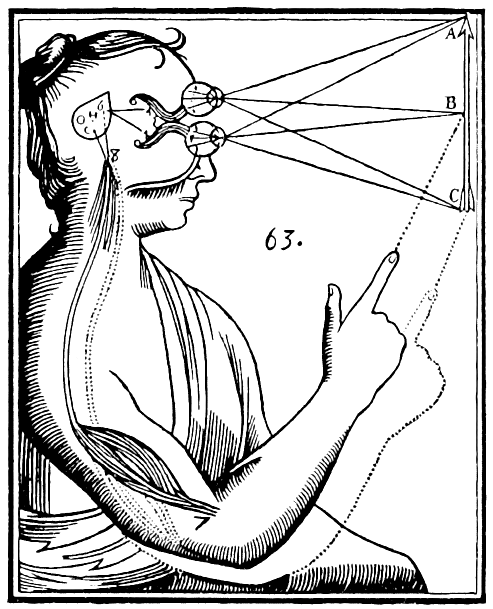
The philosophical lineage of dualism stretches back to antiquity, with Plato's theory of Forms presenting a stark separation between the eternal, perfect realm of ideas and the imperfect, material world. His student, Aristotle, offered a more integrated view, proposing a hylomorphic union where the soul is the form of the body, though he still distinguished between nutritive, sensitive, and rational souls, with the rational soul being potentially separable. Early Christian theology, particularly through figures like Augustine of Hippo, further cemented dualistic thinking by emphasizing the immortal soul's distinctness from the mortal body, a concept that profoundly shaped Western thought for over a millennium. The Renaissance and the dawn of modern philosophy saw René Descartes suggest the pineal gland as a point of interaction between mind and body, a notion widely dismissed today.
⚙️ How It Works
At its core, dualism proposes a fundamental ontological division. Substance dualism, most famously championed by René Descartes, posits that mind and body are two entirely different kinds of 'stuff' or substances. The mind is non-physical, unextended in space, and characterized by thought and consciousness, while the body is physical, extended in space, and governed by mechanical laws. Property dualism, a more contemporary variant, suggests that while there is only one kind of substance (physical), it can possess two fundamentally different kinds of properties: physical properties and non-physical mental properties, such as subjective experience or qualia. The central challenge for all dualistic theories is the problem of interaction: how can two fundamentally different kinds of entities or properties causally influence each other?
📊 Key Facts & Numbers
Dualism has been a persistent philosophical stance for millennia, with its influence evident across numerous cultures and epochs. Ancient Greek philosophers like Plato (c. 428–348 BCE) and Aristotle (384–322 BCE) laid much of the groundwork. René Descartes' seminal work is often cited as the definitive articulation of modern substance dualism. The debate between dualism and monism (particularly physicalism) remains one of the most active areas in the philosophy of mind, with hundreds of academic papers published annually on the topic.
👥 Key People & Organizations
The philosophical landscape of dualism is populated by giants. Plato, the ancient Greek philosopher, introduced early dualistic ideas through his theory of Forms. Aristotle, his student, developed a more nuanced hylomorphic view but still distinguished faculties of the soul. René Descartes, the 17th-century French philosopher and mathematician, is the most prominent proponent of substance dualism, famously posing the mind-body problem. In contemporary philosophy, figures like David Chalmers have revived dualistic arguments, particularly in relation to the 'hard problem of consciousness,' while critics like Daniel Dennett vigorously defend physicalist alternatives. Organizations like the American Philosophical Association regularly host symposia and publish journals that feature ongoing debates on dualism.
🌍 Cultural Impact & Influence
Despite the dominance of physicalist explanations in neuroscience and cognitive science, dualistic ideas persist and are undergoing re-evaluation. Contemporary property dualists, such as David Chalmers, argue that subjective experience (qualia) cannot be fully explained by physical processes alone, suggesting that consciousness might be a fundamental property of the universe, irreducible to matter. Some researchers in artificial intelligence explore the possibility of non-physical computational substrates, though this remains highly speculative. The ongoing exploration of altered states of consciousness, near-death experiences, and the subjective nature of perception continues to fuel discussions that challenge purely materialistic accounts, keeping dualism a live, albeit controversial, option in contemporary philosophy of mind.
⚡ Current State & Latest Developments
The future of dualism likely lies in more sophisticated forms of property dualism and emergentism, rather than strict substance dualism. As our understanding of consciousness deepens, philosophers and scientists may find new ways to conceptualize the relationship between mental and physical properties without resorting to two distinct substances. The development of advanced AI might also provide novel thought experiments or challenges to current physicalist paradigms. Some futurists speculate that breakthroughs in quantum physics or consciousness research could potentially offer new avenues for understanding non-physical aspects of reality, though concrete predictions remain elusive. The controversy score for dualism remains high, at 80, indicating its contentious nature.
🤔 Controversies & Debates
While direct practical applications of substance dualism are limited, its influence is felt indirectly. Religious and spiritual practices, often underpinned by dualistic beliefs in a soul separate from the body, offer frameworks for mental well-being, ethical guidance, and community for billions worldwide. In psychology, dualistic intuitions can inform therapeutic approaches that address the subjective experience of patients, even if the underlying mechanisms are explained physically. Furthermore, the philosophical arguments for dualism have spurred significant research into the nature of consciousness, driving advancements in cognitive science and neuroscience by forcing proponents of physicalism to rigorously defend their positions and explore the limits of material explanations.
🔮 Future Outlook & Predictions
Dualism is intrinsically linked to many other philosophical concepts. Its most direct counterpart is monism, the view that reality is ultimately composed of only one fundamental substance, which includes physicalism (or materialism) and idealism. The 'hard problem of consciousness,' famously articulated by David Chalmers, remains a central issue in these discussions.
Key Facts
- Category
- philosophy
- Type
- topic