
Contents
Overview
The conceptual roots of cap and trade stretch back to the 1960s and 1970s. The first large-scale implementation was the Acid Rain Program in the United States, launched under the Clean Air Act Amendments of 1990. This program successfully reduced sulfur dioxide (SO2) emissions from power plants, proving the viability of the cap and trade model. The concept gained significant traction globally as a tool for addressing climate change, leading to the establishment of the EU ETS in 2005, which has since become the world's largest carbon market. California has since adopted a similar system, with unique design features and regulatory frameworks.
⚙️ How It Works
A cap and trade system operates on a simple, yet powerful, economic principle. First, regulators establish a firm limit—the 'cap'—on the total amount of a specific pollutant, such as CO2, that can be emitted by all covered entities within a defined period. This cap is then divided into tradable allowances, with each allowance permitting the emission of one unit of the pollutant (e.g., one ton of CO2 equivalent). Companies receive or purchase these allowances, and at the end of the compliance period, they must surrender enough allowances to cover their actual emissions. If a company emits less than its allocated allowances, it can sell the surplus to another company that has exceeded its limit. This creates a financial incentive for polluters to invest in cleaner technologies and processes, as reducing emissions becomes a source of revenue or cost savings, while the cap ensures overall environmental goals are met.
📊 Key Facts & Numbers
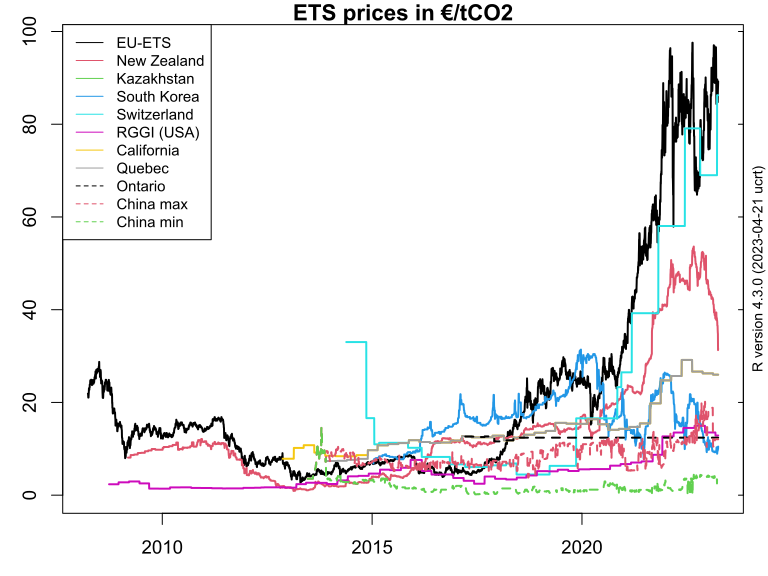
The scale of cap and trade systems is substantial and growing. The EU ETS covers approximately 40% of the EU's greenhouse gas emissions, involving over 10,000 entities and accounting for an estimated 1.5 billion tons of CO2 equivalent in its most recent compliance period. China's national ETS, launched in 2021, initially covers the power sector, representing around 4 billion tons of CO2 annually, making it the largest single-market carbon scheme globally. California's cap and trade program has generated over $10 billion in auction revenue since its inception in 2013, with a significant portion directed towards disadvantaged communities. Globally, the value of carbon markets, including cap and trade, was estimated to be over $880 billion in 2021, according to the Refinitiv Market Analysis.
👥 Key People & Organizations
Key figures in the development and advocacy of cap and trade include William D. Nordhaus, a Nobel laureate whose work on the economics of climate change heavily influenced policy discussions, and T.S. Eliot, who, despite being a poet, wrote seminal essays on the economic theory of externalities that laid groundwork for such mechanisms. In policy circles, figures like Al Gore have been vocal proponents of carbon pricing, including cap and trade, as a critical tool for climate action. Major organizations driving these systems include the UNFCCC, which facilitates international climate negotiations, and various regional bodies like the California Air Resources Board (CARB) and the European Commission, which design and oversee specific ETS programs. Think tanks such as Resources for the Future also play a crucial role in research and policy analysis.
🌍 Cultural Impact & Influence
Cap and trade systems have profoundly influenced how societies perceive and address environmental issues, shifting the discourse from purely regulatory command-and-control to market-driven solutions. The concept has permeated popular culture, appearing in discussions about corporate responsibility and the economics of sustainability. It has also spurred the growth of a new industry focused on carbon trading, verification, and consulting, creating specialized roles and expertise. The success of the Acid Rain Program served as a powerful case study, demonstrating that environmental protection and economic growth are not mutually exclusive. However, the visual representation of 'trading pollution' can also evoke negative public sentiment, highlighting a persistent challenge in public perception and communication around these complex mechanisms.
⚡ Current State & Latest Developments
As of 2024, cap and trade systems are undergoing significant evolution. The EU ETS is expanding its scope to include maritime transport and is introducing a separate emissions trading system (ETS2) for buildings and road transport. China's national ETS is gradually expanding its coverage beyond the power sector to include industries like cement, steel, and petrochemicals, while also working to incorporate more sophisticated trading mechanisms. In North America, California's program continues to operate, and discussions are ongoing in other regions about implementing or expanding similar initiatives. Technological advancements in emissions monitoring, reporting, and verification (MRV) are also enhancing the integrity and transparency of these markets, addressing historical concerns about fraud and manipulation.
🤔 Controversies & Debates
The controversies surrounding cap and trade are as persistent as the systems themselves. A primary critique is the 'hot air' problem, where initial over-allocation of allowances can lead to a surplus, depressing permit prices and undermining the incentive to reduce emissions, as seen in the early years of the EU ETS. Critics also point to potential 'carbon leakage,' where industries might relocate to regions with less stringent regulations, shifting emissions rather than reducing them globally. The equity implications are also hotly debated: who bears the cost of emissions reductions, and how are the revenues generated from allowance auctions distributed? Environmental justice advocates argue that these systems can disproportionately burden low-income communities and communities of color, who often live in areas with higher pollution levels and may face increased energy costs without commensurate benefits. The complexity of designing and implementing effective cap and trade systems also leads to ongoing debates about optimal cap levels, allowance allocation methods (free allocation vs. auctioning), and the inclusion of offsets.
🔮 Future Outlook & Predictions
The future of cap and trade appears robust, albeit with continuous refinement. Experts predict a continued expansion of these systems globally, driven by the urgent need to meet climate targets and the increasing recognition of carbon pricing as an effective policy tool. We can expect to see more sectors brought under cap and trade, including aviation and potentially agriculture, as well as the integration of these systems with other climate policies like carbon taxes and border carbon adjustments. The development of robust international carbon markets, potentially linked through Article 6 of the Paris Agreement, could further enhance efficiency and global participation. However, the success of future systems will hinge on their ability to address equity concerns, prevent carbon leakage, and maintain environmental integrity through stringent monitoring and enforcement, potentially leveraging blockchain technology for enhanced transparency and traceability.
💡 Practical Applications
Cap and trade systems have found application across a range of polluting sectors. The most prominent use is in regulating CO2 emissions from large industrial facilities and power plants, as seen in the EU ETS and China's national ETS. Beyond greenhouse gases, cap and trade principles have been applied to control other pollutants, such as sulfur dioxide (SO2) and nitrogen oxides (NOx) in the US Acid Rain Program, and volatile organic co
Key Facts
- Category
- economics
- Type
- topic