
Contents
Overview
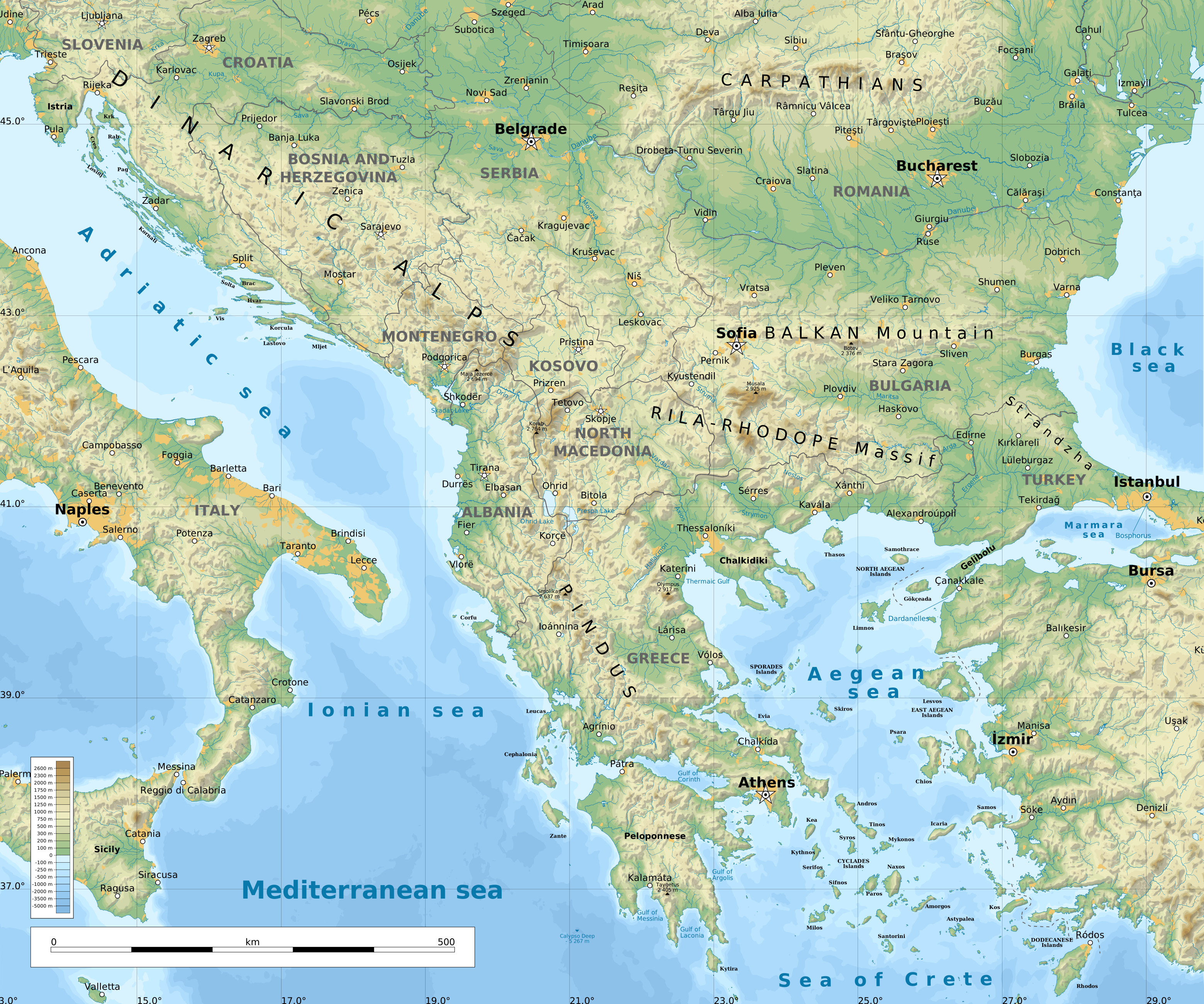
The Balkans, a sprawling geopolitical and cultural region in southeastern Europe, is defined by its complex geography and a history saturated with the rise and fall of empires. Named after the Balkan Mountains that bisect Bulgaria, the peninsula is cradled by the Adriatic, Ionian, Aegean, and Black Seas, with its northern boundaries fluid and historically contested. This region, encompassing nations like Greece, Serbia, Albania, and Bulgaria, has been a crucible for diverse ethnicities, religions, and languages, often serving as a buffer zone between Ottoman, Austro-Hungarian, and Byzantine spheres of influence. With a population exceeding 70 million and an area of approximately 470,000 square kilometers, the Balkans continues to grapple with its legacy of conflict and cooperation, making it a perpetually dynamic and fascinating geopolitical entity.
🎵 Origins & History
The very concept of the "Balkan Peninsula" was a 19th-century European construct. August Zeune envisioned the Balkan Mountains as a dominant spine stretching from the Adriatic to the Black Sea, a geographical oversimplification that quickly became a geopolitical label. Historically, this region was the stage for monumental clashes and cultural exchanges. The region's strategic location made it a perpetual frontier, a place where Eastern and Western civilizations met, mingled, and often violently collided, shaping its unique identity through centuries of flux and foreign rule.
⚙️ Defining the Region
Geographically, the Balkans are defined by a rugged topography of mountain ranges and river valleys, which has historically fostered distinct regional identities and hindered centralized control. The peninsula's maritime borders are clear: the Adriatic and Ionian Seas to the west and southwest, the Aegean to the south, and the Black Sea to the northeast. However, the northern frontier remains a point of contention, often extending to the Danube River or even further north, encompassing parts of modern-day Slovenia and Croatia. This ambiguity in definition has been exploited and reinforced by external powers throughout history, contributing to the region's complex political landscape and the enduring question of 'what constitutes the Balkans'.
📊 Key Facts & Numbers
The Balkan Peninsula spans an estimated 470,000 square kilometers, a vast territory that is home to over 70 million people. Within this area, the highest peak, Mount Musala in Bulgaria's Rila Mountains, reaches 2,925 meters (9,596 ft). The region's population density varies significantly, with urban centers like Istanbul (partially in Europe), Athens, and Belgrade serving as major hubs. Economically, the region presents a diverse picture, ranging from the more developed economies of EU members like Croatia and Bulgaria to developing economies still navigating post-socialist transitions and post-conflict recovery, with GDP per capita figures showing considerable disparities across nations.
👥 Key Peoples & Nations
The Balkans are a mosaic of distinct nations and ethnicities, including Greeks, Serbs, Croats, Albanians, Bulgarians, Romanians, Macedonians, Bosniaks, Montenegrins, and Slovenians, among others. This diversity is mirrored in its religious landscape, with significant populations of Orthodox Christians, Catholics, and Muslims, a legacy of centuries of Ottoman and Austro-Hungarian rule. The region's linguistic variety is equally rich, featuring Greek, Serbo-Croatian (with its distinct variants), Albanian, Bulgarian, and Romanian, among others. This complex ethno-linguistic tapestry has been both a source of vibrant cultural exchange and, at times, profound conflict, particularly during the tumultuous 20th century.
🌍 Cultural Impact & Influence
The cultural output of the Balkans has profoundly influenced global arts, music, and literature, often through the lens of its turbulent history. From the haunting melodies of Sevdalinka music in Bosnia to the vibrant folk traditions of Romania and the cinematic narratives of directors like Emir Kusturica, the region's artistic expressions are deeply rooted in its unique socio-political context. The "Balkanization" phenomenon, a term coined to describe the fragmentation of a larger entity into smaller, often mutually hostile states, has become a recognized geopolitical concept, reflecting the region's historical trajectory. Furthermore, the culinary traditions, a fusion of Mediterranean, Central European, and Middle Eastern influences, offer a delicious testament to the region's historical interactions.
⚡ Current State & Latest Developments
In the early 21st century, the Balkans remain a region in transition, with many nations striving for greater integration into European Union and NATO structures, while others navigate complex internal challenges and regional disputes. Countries like Croatia and Bulgaria are now full EU members, while others, such as Serbia and Albania, are in various stages of accession talks. The lingering effects of the Yugoslav Wars of the 1990s continue to shape regional politics, particularly concerning the status of Kosovo and inter-ethnic relations in Bosnia and Herzegovina. Economic development remains a key focus, with efforts to attract foreign investment and combat corruption, though progress is uneven across the diverse states.
🤔 Controversies & Debates
The term "Balkanization" itself is a significant controversy, often used pejoratively to describe the fragmentation and conflict inherent in the region, a label many Balkan intellectuals and citizens find reductive and unfair. The ongoing territorial disputes, particularly surrounding Kosovo's independence, which is recognized by some states but not others (including Serbia, Russia, and China), remain a major point of contention. Furthermore, the historical narratives surrounding World War I, often attributed to a "Balkan spark," and the complex legacy of socialist rule under figures like Josip Broz Tito continue to be debated and reinterpreted, highlighting differing national perspectives and unresolved historical grievances.
🔮 Future Outlook & Predictions
The future of the Balkans is intrinsically linked to its ongoing integration with European structures, though the pace and success of this process remain uncertain. The potential for renewed ethnic tensions, particularly in the Western Balkans, is a persistent concern, exacerbated by external influences from powers like Russia and Turkey. Economic development and the fight against corruption are crucial for stability, with significant investment needed in infrastructure and human capital. The resolution of outstanding territorial disputes, especially concerning Kosovo, will be pivotal in determining the long-term peace and prosperity of the region. Some futurists predict a gradual convergence with Western Europe, while others foresee continued fragmentation and instability.
💡 Practical Applications
The Balkans' strategic location has historically made it a vital transit corridor for trade and migration between Europe and Asia. Today, this role continues, with major infrastructure projects like the Pan-European Corridors facilitating the movement of goods and people across the region. The diverse cultural heritage also presents significant opportunities for tourism, attracting visitors interested in history, natural beauty, and unique cultural experiences. Furthermore, the region's complex political and social dynamics offer fertile ground for academic research in fields such as political science, sociology, and international relations, with numerous universities and research institutions dedicated to Balkan studies.
Key Facts
- Category
- history
- Type
- topic