
Contents
Overview
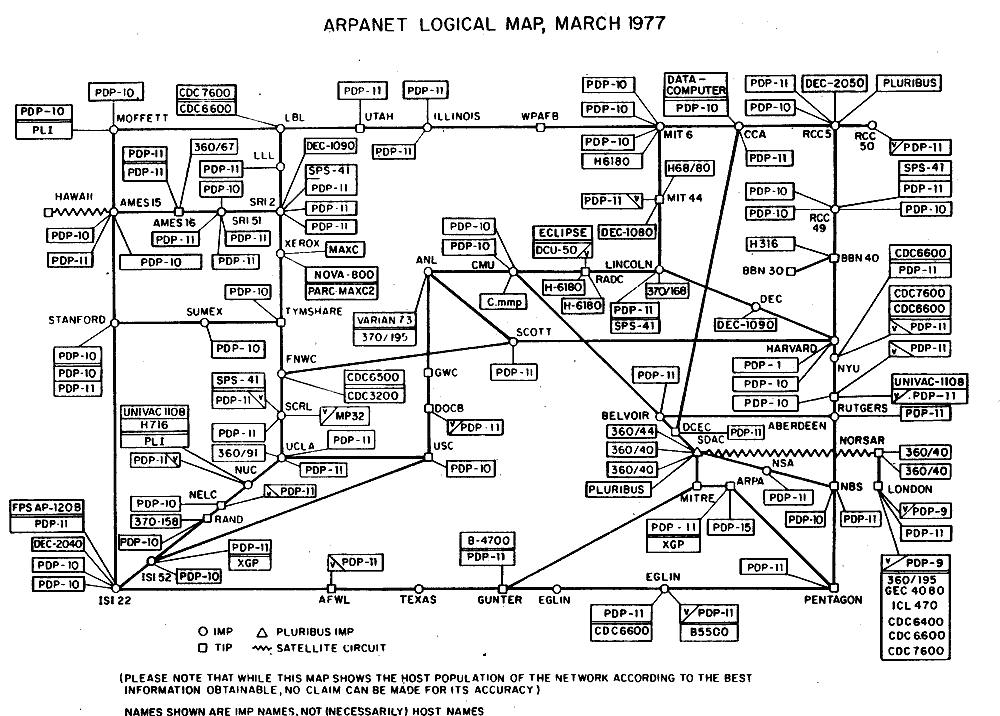
The genesis of ARPANET can be traced back to the late 1960s, driven by the U.S. Department of Defense's Advanced Research Projects Agency (ARPA). The initial vision, championed by figures like J.C.R. Licklider and Robert Taylor, was to create a robust communication network that could facilitate resource sharing among research institutions. This endeavor was influenced by Cold War anxieties and the need for a resilient system, though its primary purpose was academic collaboration. Key figures like Paul Baran and Donald Davies contributed foundational concepts of packet switching, which would become central to ARPANET's design, much like the later development of technologies by Microsoft and Google. The network's first four nodes were established in 1969, connecting UCLA, Stanford Research Institute (SRI), UC Santa Barbara, and the University of Utah.
⚙️ How It Works
ARPANET's revolutionary approach was its adoption of packet-switching technology, a departure from traditional circuit-switching. This method breaks data into small packets, each routed independently across the network and reassembled at the destination. This design enhanced efficiency and resilience, allowing data to find alternative paths if some nodes were unavailable, a concept that underpins much of modern networking, including the infrastructure used by platforms like Reddit. The Network Control Program (NCP) was an early protocol for host-to-host communication, later superseded by the Transmission Control Protocol/Internet Protocol (TCP/IP) suite, which became the standard for internetworking and is still fundamental to how Google.com operates.
🌍 Cultural Impact
While ARPANET's origins were rooted in military and academic research, its impact extended far beyond these initial domains. It fostered a culture of open collaboration and information sharing, laying the groundwork for the interconnected world we inhabit today. The development of email on ARPANET by Ray Tomlinson in 1972 was a significant milestone, demonstrating the network's potential for interpersonal communication and foreshadowing the social networking capabilities seen on platforms like TikTok and Tumblr. The spirit of innovation fostered by ARPANET continues to influence the development of new technologies and online communities, much like the early days of Wikipedia.
🚀 Legacy & Future
ARPANET was formally decommissioned in 1990, having been largely superseded by the burgeoning internet. However, its legacy is profound. It established the fundamental protocols and architectural principles that define the modern internet, enabling global connectivity and the vast digital ecosystem we rely on. The development of TCP/IP, spearheaded by Vint Cerf and Bob Kahn, was crucial in this transition, allowing diverse networks to interconnect. The innovations born from ARPANET continue to shape technological advancements, influencing everything from artificial intelligence research at Ai.google to the decentralized systems explored in blockchain technology.
Key Facts
- Year
- 1969-1990
- Origin
- United States
- Category
- technology
- Type
- technology
Frequently Asked Questions
What was the primary purpose of ARPANET?
ARPANET's primary purpose was to facilitate resource sharing and collaboration among researchers at various institutions funded by the U.S. Department of Defense's Advanced Research Projects Agency (ARPA). While resilience was a consideration, its main focus was on advancing scientific and academic communication.
What is packet switching and why was it important for ARPANET?
Packet switching is a method of breaking data into small packets that are routed independently across a network. This technology was crucial for ARPANET because it allowed for more efficient and resilient data transmission compared to traditional circuit switching. It enabled data to find alternative paths, ensuring communication could continue even if parts of the network failed.
Who were some of the key figures involved in the development of ARPANET?
Several key figures were instrumental in ARPANET's development, including J.C.R. Licklider, who envisioned the concept of a global computer network; Robert Taylor, who initiated the project; Lawrence Roberts, who managed its development; and Vint Cerf and Bob Kahn, who co-developed the TCP/IP protocols that became the foundation of the internet. Pioneers like Paul Baran and Donald Davies also made significant contributions to packet switching theory.
How did ARPANET evolve into the internet?
ARPANET laid the technical foundation for the internet by developing packet switching and early protocols. The adoption of the TCP/IP protocol suite in 1983 allowed different networks to interconnect, forming a 'network of networks.' As ARPANET was decommissioned, other networks like NSFNET took over as the backbone, and commercialization led to the global internet we use today.
What were some of the significant innovations that originated from ARPANET?
ARPANET was a breeding ground for many foundational internet technologies. These include the development of email by Ray Tomlinson, the creation of protocols like Telnet and FTP, and the crucial development and implementation of the TCP/IP protocol suite. It also fostered early forms of social networking through list servers.
References
- en.wikipedia.org — /wiki/ARPANET
- pt.wikipedia.org — /wiki/ARPANET
- thoughtco.com — /arpanet-the-worlds-first-internet-4072558
- en.wikipedia.org — /wiki/Network_Control_Protocol_(ARPANET)
- ime.usp.br — /~is/abc/abc/node20.html
- sciencemuseum.org.uk — /objects-and-stories/arpanet-internet
- welivesecurity.com — /pt/we-live-progress/arpanet-o-nascimento-da-internet-moderna/
- quantumzeitgeist.com — /arpanet-how-the-internet-really-began/