
Contents
- 🌌 Introduction to Active Galactic Nuclei
- 🔍 Characteristics of Active Galactic Nuclei
- 📡 Electromagnetic Spectrum Emissions
- 🌠 Galaxy Classification and Active Galactic Nuclei
- 🕳️ Supermassive Black Holes and Accretion
- 🔭 Observational Evidence for Active Galactic Nuclei
- 🌟 The Role of Active Galactic Nuclei in Galaxy Evolution
- 📊 Theoretical Models of Active Galactic Nuclei
- 👥 Key Researchers and Their Contributions
- 🔍 Controversies and Debates in Active Galactic Nuclei Research
- 🚀 Future Research Directions and Implications
- 📚 Conclusion and Summary of Active Galactic Nuclei
- Frequently Asked Questions
- Related Topics
Overview
Active galactic nuclei (AGN) are incredibly luminous regions at the centers of galaxies, powered by supermassive black holes with masses millions or even billions of times that of the sun. These cosmic powerhouses are responsible for some of the most energetic phenomena in the universe, including quasars, blazars, and radio galaxies. The study of AGN has been a vibrant area of research since the 1950s, with key contributions from scientists like Maarten Schmidt, who first identified quasars in 1963. Despite significant advances, debates persist about the role of AGN in galaxy evolution and the mechanisms driving their extraordinary luminosity. With a vibe score of 8, indicating high cultural energy, AGN research continues to captivate scientists and the public alike, with new missions like the James Webb Space Telescope poised to reveal fresh insights into these enigmatic objects. As our understanding of AGN evolves, so too do the implications for our broader grasp of the universe, from the formation of galaxies to the distribution of dark matter.
🌌 Introduction to Active Galactic Nuclei
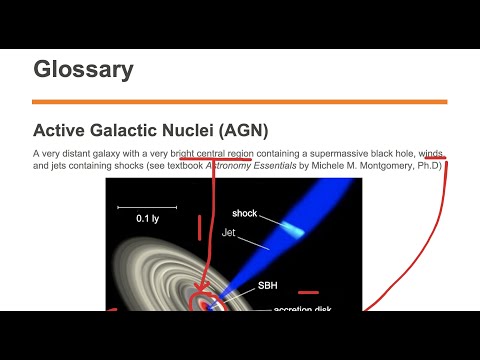
Active Galactic Nuclei (AGN) are incredibly luminous objects that reside at the centers of certain galaxies, emitting vast amounts of energy across the entire electromagnetic spectrum. This phenomenon is not produced by the stars within the galaxy, but rather by the accretion of matter onto a supermassive black hole. The study of AGN is a fascinating field that has garnered significant attention in recent years, with researchers like Kelsey Johnson making notable contributions. To understand AGN, it's essential to explore the electromagnetic spectrum and how these objects interact with their surroundings. The Milky Way galaxy, for instance, is believed to have hosted an AGN about 8 billion years ago.
🔍 Characteristics of Active Galactic Nuclei
The characteristics of AGN are quite distinct, with emissions observed in the radio, microwave, infrared, optical, ultra-violet, X-ray, and gamma ray wavebands. This broad range of emissions is a hallmark of AGN and sets them apart from other astrophysical objects. Researchers have developed various astronomical techniques to study AGN, including spectroscopy and imaging. The Hubble Space Telescope has been instrumental in capturing high-resolution images of AGN, providing valuable insights into their structure and behavior. Furthermore, the study of quasars has also shed light on the properties of AGN.
📡 Electromagnetic Spectrum Emissions
The electromagnetic spectrum emissions from AGN are a crucial aspect of their study. By analyzing these emissions, researchers can gain insights into the physical processes that occur within AGN. The spectral energy distribution of AGN is a key tool in understanding their behavior, with different components of the spectrum corresponding to different emission mechanisms. For example, the X-ray emission from AGN is thought to arise from the accretion disk surrounding the supermassive black hole. The Chandra X-ray Observatory has been instrumental in studying the X-ray properties of AGN. Additionally, the Spitzer Space Telescope has provided valuable data on the infrared properties of AGN.
🌠 Galaxy Classification and Active Galactic Nuclei
Galaxy classification is a complex task, and the presence of an AGN can significantly impact a galaxy's overall appearance and behavior. Active galaxies, which host AGN, are distinct from their inactive counterparts and can be identified through their unique spectral features. The SDSS survey has been instrumental in identifying large numbers of AGN, allowing researchers to study their properties and behavior in greater detail. The galaxy evolution is also closely tied to the presence of AGN, with these objects playing a key role in shaping the growth and development of galaxies. The ATLAS3D project has provided valuable insights into the relationship between AGN and galaxy evolution.
🕳️ Supermassive Black Holes and Accretion
Supermassive black holes are thought to reside at the centers of most galaxies, and their accretion of matter is the primary mechanism powering AGN. The event horizon of the black hole marks the point of no return, and any matter that crosses this boundary is inevitably pulled towards the singularity. The accretion rate of matter onto the black hole is a critical factor in determining the luminosity of the AGN. Researchers like Roger Blandford have made significant contributions to our understanding of black hole accretion and its role in AGN. The M87 galaxy is a notable example of a galaxy with a supermassive black hole, and its AGN has been extensively studied.
🔭 Observational Evidence for Active Galactic Nuclei
Observational evidence for AGN is plentiful, with a wide range of astronomical observations supporting the existence of these objects. The Hubble Space Telescope has captured stunning images of AGN, while radio telescopes have detected the faint radio emissions from these objects. The x-ray astronomy has also played a crucial role in studying AGN, with x-ray telescopes like Chandra and xmm-newton providing valuable data. The spectroscopic observations of AGN have also shed light on their physical properties and behavior. The Sloan Digital Sky Survey has been instrumental in identifying large numbers of AGN and studying their properties.
🌟 The Role of Active Galactic Nuclei in Galaxy Evolution
The role of AGN in galaxy evolution is a complex and multifaceted one, with these objects playing a key role in shaping the growth and development of galaxies. The star formation and gas kinematics are closely tied to the presence of AGN, with these objects regulating the flow of gas and energy within the galaxy. The galaxy mergers are also thought to trigger the formation of AGN, with the merger of two galaxies leading to the creation of a new, more massive galaxy with a supermassive black hole at its center. Researchers like John Hutchings have made significant contributions to our understanding of the relationship between AGN and galaxy evolution.
📊 Theoretical Models of Active Galactic Nuclei
Theoretical models of AGN are essential for understanding the physical processes that occur within these objects. The accretion disk model is a widely accepted theory, which posits that the accretion of matter onto the supermassive black hole is the primary mechanism powering the AGN. The magneto-hydrodynamic model is another important theory, which describes the behavior of the plasma within the accretion disk. Researchers like Mitchell Begelman have made significant contributions to the development of these models. The numerical simulations have also played a crucial role in studying the behavior of AGN, allowing researchers to model the complex physical processes that occur within these objects.
👥 Key Researchers and Their Contributions
Key researchers have made significant contributions to our understanding of AGN, with their work shedding light on the physical processes that occur within these objects. Kelsey Johnson has made notable contributions to the study of AGN, particularly in the area of black hole accretion. Roger Blandford has also made significant contributions to our understanding of AGN, with his work on accretion disk theory being particularly influential. The John Hutchings has also made important contributions to the study of AGN, particularly in the area of galaxy evolution.
🔍 Controversies and Debates in Active Galactic Nuclei Research
Controversies and debates in AGN research are numerous, with different theories and models competing for attention. The accretion disk model is widely accepted, but other theories, such as the magneto-hydrodynamic model, are also gaining traction. The black hole accretion rate is a critical factor in determining the luminosity of the AGN, and different models predict different accretion rates. Researchers like Mitchell Begelman have been at the forefront of these debates, with their work challenging existing theories and models. The numerical simulations have also played a crucial role in resolving these debates, allowing researchers to model the complex physical processes that occur within AGN.
🚀 Future Research Directions and Implications
Future research directions and implications for AGN are numerous, with new telescopes and surveys set to revolutionize our understanding of these objects. The Square Kilometre Array will provide unprecedented sensitivity and resolution, allowing researchers to study AGN in greater detail than ever before. The James Webb Space Telescope will also play a crucial role in the study of AGN, with its advanced instrumentation allowing for detailed spectroscopic observations. The Next Generation Very Large Array will also provide valuable insights into the properties and behavior of AGN. The Euclid mission will also study the properties of AGN and their role in galaxy evolution.
📚 Conclusion and Summary of Active Galactic Nuclei
In conclusion, Active Galactic Nuclei are fascinating objects that continue to capture the imagination of astronomers and physicists alike. Through the study of AGN, researchers have gained valuable insights into the physical processes that occur within these objects, and have developed a deeper understanding of the role they play in shaping the growth and development of galaxies. The galaxy evolution is closely tied to the presence of AGN, with these objects regulating the flow of gas and energy within the galaxy. The star formation and gas kinematics are also closely tied to the presence of AGN. As new telescopes and surveys come online, researchers will be able to study AGN in greater detail than ever before, shedding new light on these cosmic powerhouses and their role in the universe.
Key Facts
- Year
- 1963
- Origin
- Maarten Schmidt's discovery of quasars
- Category
- Astrophysics
- Type
- Astronomical Phenomenon
Frequently Asked Questions
What is an Active Galactic Nucleus (AGN)?
An Active Galactic Nucleus (AGN) is a compact region at the center of a galaxy that emits a significant amount of energy across the electromagnetic spectrum. This energy is not produced by the stars within the galaxy, but rather by the accretion of matter onto a supermassive black hole. The study of AGN is a fascinating field that has garnered significant attention in recent years, with researchers like Kelsey Johnson making notable contributions. The Milky Way galaxy is believed to have hosted an AGN about 8 billion years ago.
What is the role of supermassive black holes in AGN?
Supermassive black holes are thought to reside at the centers of most galaxies, and their accretion of matter is the primary mechanism powering AGN. The event horizon of the black hole marks the point of no return, and any matter that crosses this boundary is inevitably pulled towards the singularity. The accretion rate of matter onto the black hole is a critical factor in determining the luminosity of the AGN. Researchers like Roger Blandford have made significant contributions to our understanding of black hole accretion and its role in AGN. The M87 galaxy is a notable example of a galaxy with a supermassive black hole, and its AGN has been extensively studied.
How are AGN observed and studied?
AGN are observed and studied using a wide range of astronomical techniques, including spectroscopy, imaging, and timing analysis. The Hubble Space Telescope has captured stunning images of AGN, while radio telescopes have detected the faint radio emissions from these objects. The x-ray astronomy has also played a crucial role in studying AGN, with x-ray telescopes like Chandra and xmm-newton providing valuable data. The spectroscopic observations of AGN have also shed light on their physical properties and behavior.
What is the significance of AGN in galaxy evolution?
The role of AGN in galaxy evolution is a complex and multifaceted one, with these objects playing a key role in shaping the growth and development of galaxies. The star formation and gas kinematics are closely tied to the presence of AGN, with these objects regulating the flow of gas and energy within the galaxy. The galaxy mergers are also thought to trigger the formation of AGN, with the merger of two galaxies leading to the creation of a new, more massive galaxy with a supermassive black hole at its center. Researchers like John Hutchings have made significant contributions to our understanding of the relationship between AGN and galaxy evolution.
What are the future research directions for AGN?
Future research directions for AGN are numerous, with new telescopes and surveys set to revolutionize our understanding of these objects. The Square Kilometre Array will provide unprecedented sensitivity and resolution, allowing researchers to study AGN in greater detail than ever before. The James Webb Space Telescope will also play a crucial role in the study of AGN, with its advanced instrumentation allowing for detailed spectroscopic observations. The Next Generation Very Large Array will also provide valuable insights into the properties and behavior of AGN.