
Contents
- 🎵 Origins & History
- ⚙️ How It Works
- 📊 Key Facts & Numbers
- 👥 Key People & Organizations
- 🌍 Cultural Impact & Influence
- ⚡ Current State & Latest Developments
- 🤔 Controversies & Debates
- 🔮 Future Outlook & Predictions
- 💡 Practical Applications
- 📚 Related Topics & Deeper Reading
- Frequently Asked Questions
- References
- Related Topics
Overview
The road to the 2016 election began with incumbent Democratic President Barack Obama being ineligible for a third term due to the Twenty-second Amendment. The Democratic primary saw former Secretary of State Hillary Clinton narrowly defeat Senator Bernie Sanders, making her the first female presidential nominee of a major American party. On the Republican side, a crowded field of candidates, including Ted Cruz, Marco Rubio, and Jeb Bush, was unexpectedly dominated by businessman Donald Trump. Trump, initially dismissed by many in the Republican Party establishment, leveraged a populist message and a direct appeal to working-class voters, particularly in the Rust Belt states. His campaign, often characterized by rallies and extensive social media engagement, tapped into a deep vein of discontent with the political status quo, setting the stage for a highly unconventional contest against Clinton, who represented a more traditional political path.
⚙️ How It Works
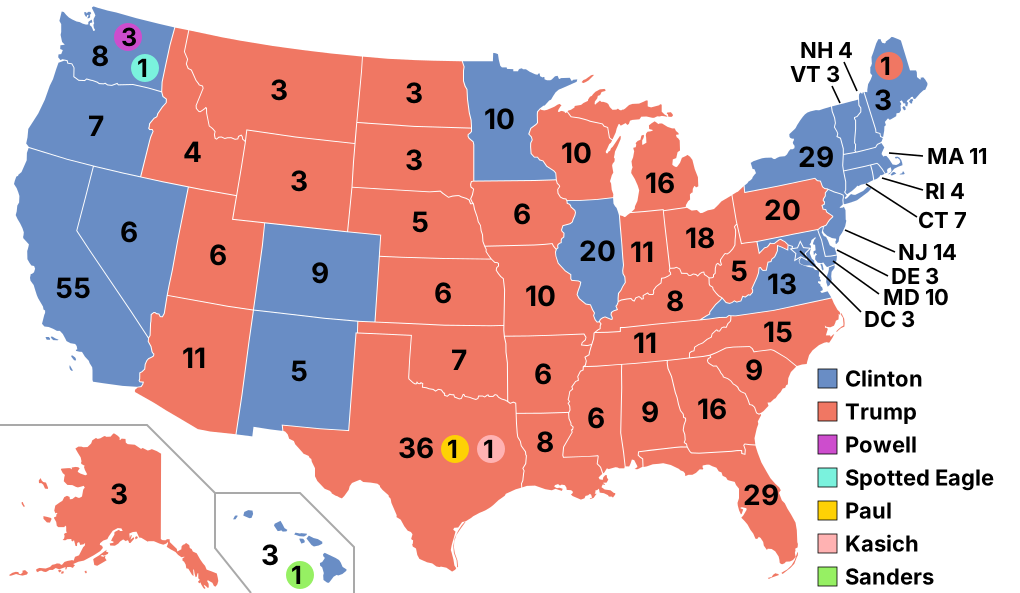
The U.S. presidential election operates through the Electoral College system, where citizens vote for electors who then cast votes for president. Each state receives a number of electors equal to its total number of senators and representatives in Congress. In most states, the candidate who wins the popular vote receives all of that state's electoral votes (winner-take-all). A candidate needs a majority of electoral votes—at least 270 out of 538—to win the presidency. The 2016 election highlighted the divergence between the national popular vote and the Electoral College outcome. While Clinton won nearly 2.9 million more individual votes nationwide, Trump secured 304 electoral votes to Clinton's 227, a stark illustration of how the system can produce a president who did not receive the most votes. This mechanism, established by the U.S. Constitution, has been a recurring point of contention in American elections.
📊 Key Facts & Numbers
The 2016 election was a statistical anomaly in several key ways. Donald Trump won 304 electoral votes compared to Hillary Clinton's 227, despite Clinton winning the national popular vote by a margin of 2.86 million votes. Trump secured victory in states that had previously voted Democratic in recent presidential elections, such as Pennsylvania, Michigan, and Wisconsin, flipping the traditional "Blue Wall" of states. Voter turnout was approximately 59.2% of the voting-eligible population, a slight decrease from the 2012 election. Trump's campaign spent an estimated $2.1 billion, while Clinton's campaign spent approximately $1.5 billion. The election saw a significant number of protest votes and write-ins, with over 40,000 votes cast for third-party candidates like Libertarian nominee Gary Johnson and Green Party nominee Jill Stein.
👥 Key People & Organizations
The central figures of the 2016 election were Republican nominee Donald Trump and Democratic nominee Hillary Clinton. Trump, a New York-based businessman and former reality television star, ran on an "America First" platform, promising to renegotiate trade deals and build a wall on the U.S.-Mexico border. Clinton, a former First Lady, U.S. Senator from New York, and Secretary of State under Barack Obama, campaigned on continuing Obama's policies and expanding healthcare access. Key organizations involved included the Democratic National Committee (DNC) and the Republican National Committee (RNC), whose primary functions are to support their party's candidates. Cambridge Analytica, a political consulting firm, played a controversial role in Trump's campaign by using data analytics for targeted advertising. The Federal Election Commission (FEC) oversees campaign finance regulations.
🌍 Cultural Impact & Influence
The 2016 election had a profound and lasting impact on American culture and discourse. It amplified existing societal divisions and brought issues of identity, immigration, and economic inequality to the forefront of national conversation. Trump's victory signaled a shift in political strategy, demonstrating the power of populist appeals and direct communication channels like Twitter to bypass traditional media gatekeepers. The election also spurred increased political engagement, particularly among younger voters and minority groups, and led to the rise of various activist movements, including the Women's March and the "resistance" movement. The concept of "fake news" gained widespread prominence, highlighting concerns about misinformation and its influence on public opinion, a phenomenon amplified by social media platforms.
⚡ Current State & Latest Developments
In the immediate aftermath of the 2016 election, the focus shifted to the transition of power and the initial policy initiatives of the Trump administration. The ongoing investigations into Russian interference in the election, particularly the findings of the Mueller Report, continued to shape political discourse and congressional oversight throughout Trump's term. The election's outcome also influenced subsequent elections, including the 2018 midterm elections and the 2020 presidential election, where Trump sought re-election. The debates surrounding election integrity, voter suppression, and the role of social media in politics, all heightened by the 2016 cycle, remain active areas of concern and policy discussion in U.S. politics as of 2024.
🤔 Controversies & Debates
The 2016 election is rife with controversies. The most significant was the allegation of Russian interference, with intelligence agencies concluding that Russia had engaged in a campaign to influence the election outcome, including hacking and disseminating emails from the DNC and the Clinton campaign. The role of FBI Director James Comey's public statements regarding the investigation into Clinton's private email server, just days before the election, remains a subject of intense debate. Furthermore, Trump's rhetoric, which critics deemed inflammatory and divisive, particularly concerning women, minorities, and immigrants, sparked widespread protests and accusations of xenophobia and racism. The use of microtargeting by Cambridge Analytica also raised ethical questions about data privacy and the manipulation of voters.
🔮 Future Outlook & Predictions
The long-term implications of the 2016 election continue to unfold. Trump's presidency fundamentally altered the Republican Party's platform and voter base, solidifying a populist, nationalist wing. The election's outcome has also prompted ongoing discussions about the future of American democracy, the role of traditional media versus social media, and the effectiveness of the Electoral College. Experts predict that the themes of economic populism and cultural grievances that propelled Trump to victory will continue to be significant forces in American politics for years to come. The increasing polarization observed in 2016 is likely to persist, posing challenges for bipartisan cooperation and national unity. The role of foreign interference in democratic elections remains a critical concern for national security and electoral integrity.
💡 Practical Applications
While the 2016 election itself is a historical event, its mechanics and consequences offer lessons for various fields. The campaign strategies employed by Donald Trump, particularly his use of social media and direct-to-voter communication, have become case studies in modern political marketing and digital strategy. The data analytics employed by firms like Cambridge Analytica have spurred advancements and ethical debates in political science and data analytics. The election also highlighted the importance of understanding voter sentiment and the impact of economic anxieties on political outcomes, influencing how pollsters and political strategists approach future campaigns. The legal and regulatory frameworks surrounding campaign finance and election security have been re-examined in light of the controversies that emerged.
Key Facts
- Year
- 2016
- Origin
- United States
- Category
- history
- Type
- event
Frequently Asked Questions
Who won the 2016 US presidential election?
Donald Trump won the 2016 US presidential election. He secured 304 electoral votes, defeating Democratic nominee Hillary Clinton, who received 227 electoral votes. Despite winning the presidency, Trump lost the national popular vote to Clinton by nearly 2.9 million votes, making it the fifth time in U.S. history that the Electoral College winner did not win the popular vote. This outcome highlighted the significant impact of the Electoral College system on presidential election results.
What were the main issues in the 2016 election?
The 2016 election was characterized by several key issues, including immigration, trade policy, and national security. Donald Trump's campaign focused on building a wall on the U.S.-Mexico border and renegotiating trade deals like NAFTA, appealing to voters concerned about job losses and illegal immigration. Hillary Clinton emphasized continuing Barack Obama's policies, expanding healthcare access, and addressing income inequality. The election also saw significant debate around political correctness, cultural identity, and the perceived disconnect between political elites and ordinary citizens, issues amplified by social media and the rise of populism.
Was there foreign interference in the 2016 election?
Yes, multiple U.S. intelligence agencies concluded that Russia engaged in a deliberate campaign to interfere with the 2016 election. This interference reportedly included hacking into the DNC and Clinton campaign computer systems, releasing stolen information through entities like WikiLeaks, and conducting a social media disinformation campaign to sow discord and influence public opinion. The Mueller Report detailed these efforts, though it did not establish a criminal conspiracy between the Trump campaign and the Russian government. The findings have led to ongoing debates about election security and the potential for future foreign interference.
Why is the 2016 election considered a major upset?
The 2016 election is widely considered a major upset because virtually all pre-election polls, political analysts, and media outlets predicted a victory for Hillary Clinton. Donald Trump, a political outsider with no prior elected office experience, defied these expectations by winning key swing states like Pennsylvania, Michigan, and Wisconsin, states that had consistently voted for Democratic presidential candidates for decades. His victory was attributed to a combination of factors, including strong support from working-class voters, effective use of social media, and a perceived failure of the Clinton campaign to connect with certain segments of the electorate. The outcome demonstrated a significant disconnect between polling data and the actual voting behavior of a substantial portion of the American populace.
What was the role of 'fake news' in the 2016 election?
The 2016 election brought the phenomenon of 'fake news' into mainstream discourse. Fabricated news stories, often designed to be sensational and emotionally charged, circulated widely on social media platforms like Facebook and Twitter. These stories, which sometimes mimicked legitimate news sources, aimed to mislead voters and influence their perceptions of candidates, particularly Hillary Clinton. Research suggests that these false narratives were shared extensively and may have had an impact on voter attitudes, contributing to the erosion of trust in traditional media and exacerbating political polarization. The spread of fake news highlighted challenges in content moderation and media literacy in the digital age.
How did the 2016 election impact the Republican Party?
The 2016 election marked a significant transformation for the Republican Party. Donald Trump's victory signaled a shift away from traditional conservative orthodoxy towards a more populist and nationalist platform. His success demonstrated the power of appealing directly to working-class voters, particularly in the Rust Belt, and prioritizing issues like trade protectionism and immigration restriction. The party's leadership and policy priorities evolved to align more closely with Trump's agenda, leading to internal debates and realignments. The election solidified Trump's influence within the party, shaping its messaging, candidate recruitment, and electoral strategies in subsequent years.
What are the long-term consequences of the 2016 election?
The long-term consequences of the 2016 election are multifaceted and continue to be felt. It ushered in an era of heightened political polarization in the United States, with deep divisions on issues ranging from immigration and healthcare to the role of government. The election also led to increased scrutiny of election security and the potential for foreign interference. The Trump presidency itself brought significant policy changes, including tax cuts, deregulation, and a shift in foreign policy. Furthermore, the election's outcome and the subsequent political climate have influenced social movements, media consumption habits, and the overall tone of public discourse, leaving a lasting imprint on American society and its political trajectory.